

Why Do Your Glasses Look Crooked? 3 Effortless Ways to Fix

If you’ve ever looked in the mirror, taken a photo, or joined a video call and thought,
“Why do your glasses look crooked?”
you’re not imagining it.
(Quick Answer)
- Glasses usually look crooked because faces are naturally uneven, not because the frames are defective.
- The three most common causes are uneven ears, nose asymmetry, and poor frame balance.
- Most crooked glasses can be fixed with simple adjustments, not replacements.
- Frame design and weight distribution matter more than most people realize.
- If your glasses look crooked but feel fine, photos and camera angles may be exaggerating the issue.
This is one of the most common eyewear complaints and one of the least clearly explained.
Your glasses may look fine on the table. They may even feel “okay” when you put them on. But once they’re on your face, something feels off. One lens sits higher. The frame tilts. Your eyes don’t line up evenly. And once you notice it, you can’t unsee it.
The good news?
Most crooked glasses are not broken.
They’re just out of balance.
In this guide, we’ll break down why glasses become uneven, how to fix them safely, and—most importantly how to stop the problem from happening again.
No technical jargon. No medical claims. Just real-world explanations that actually make sense.
Table of Contents
Why Crooked Glasses Are So Common (And Why It’s Not Your Fault)
Here’s something almost no one tells you before you buy glasses:
Human faces are not symmetrical.
One ear sits higher.
One side of the nose slopes differently.
One eye is slightly more forward.
This is normal. In fact, perfectly symmetrical faces are extremely rare.
But glasses are manufactured to be symmetrical.
Straight temples. Even lens height. Balanced bridge.
So when a symmetrical object sits on an asymmetrical surface, something has to give.
That “give” is what you see as crooked glasses.
The 3 Most Common Reasons Why Do Your Glasses Look Crooked
Let’s break this down clearly.
1. Your Ears Are Uneven (Yes, Almost Everyone’s Are)
This is the number one reason glasses tilt.
If one ear sits higher than the other, the temple arm on that side gets lifted. The result?
The entire frame angles downward on the opposite side.
Signs this is your issue:
- One lens always looks higher
- The glasses tilt the same way every time
- The tilt gets worse when you turn your head
This has nothing to do with bad frames. It’s anatomy.
2. Your Nose Isn’t Centered (And That’s Normal)
Most noses are not perfectly centered or symmetrical.
When glasses rest on the nose bridge, even a small difference in slope or height can cause a tilt.
Common clues:
- Glasses slide more on one side
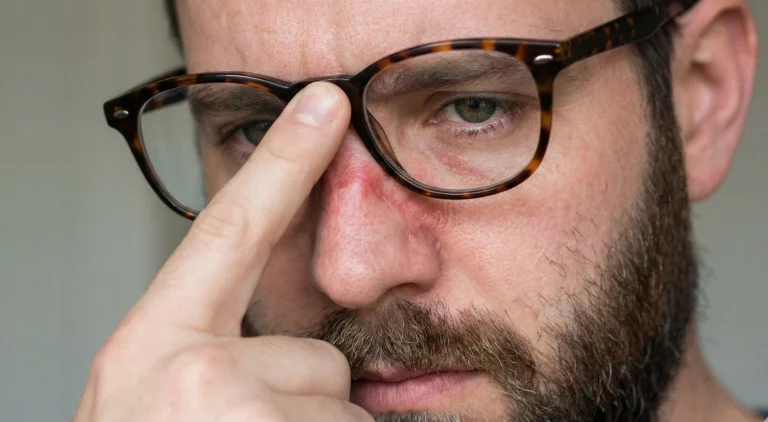
- One nose pad leaves a deeper mark (See our guide on Glasses Leave Marks on Nose Due to Bad Nose Pads)
- The frame feels stable but looks uneven
This is especially common with:
- Lightweight frames
- Fixed plastic bridges
- Smooth nose materials
3. Poor Frame Balance (The Hidden Cause)
Even if your ears and nose were perfectly even, glasses can still look crooked if the weight distribution is off.
This happens when:
- Lenses are thick or heavy (See our guide on How to Hide Thick Lenses)
- The frame front is heavier than the temples
- The temple tips don’t counterbalance the lenses
The result is a subtle forward or sideways “pull” that causes the frame to rotate slightly on your face.
This is why two people can wear the same glasses and only one sees the issue.
3 Easy Ways to Fix Crooked Glasses (Without Replacing Them)
Now let’s talk solutions.
These are safe, practical fixes that address the actual causes—not cosmetic tricks.
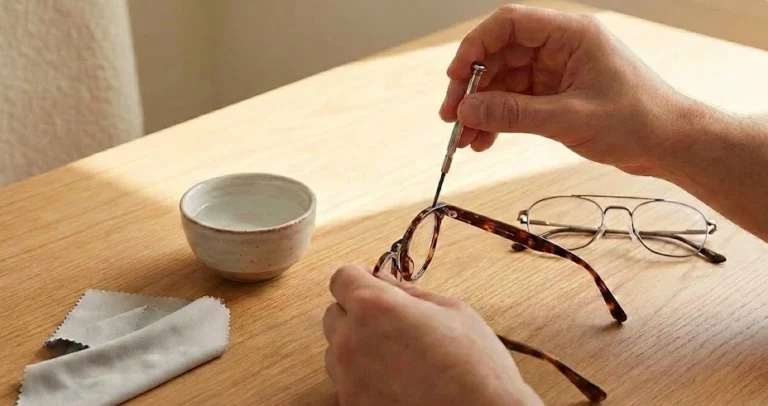
Fix #1: Adjust the Temple Arms (The Most Effective Fix)
The temple arms control how your glasses sit relative to your ears.
If one side is higher:
- The arm on the higher side usually needs a slightly deeper curve
- The opposite arm may need to be straightened slightly
What this does:
- Levels the frame front
- Corrects tilt without changing lens position
- Improves long-term comfort
Important note:
If your glasses are metal or flexible material, adjustments are easier.
If they’re rigid plastic, adjustments should be gentle and minimal.
This single fix solves the majority of crooked-glasses complaints.
Fix #2: Balance the Nose Contact (Not Just Tightening)
Many people try to “tighten” glasses to fix crookedness. This often makes things worse.
Instead, the goal is balanced contact, not pressure.
If your frame has nose pads:
- Slightly widen the pad on the side that sits higher
- Narrow the pad on the side that slides
If your frame has a fixed bridge:
- Make sure the frame sits level, not angled forward
- Lighter frames help more than expected
Balanced nose contact stops the frame from rotating unevenly.
Fix #3: Improve Weight Distribution (The Long-Term Fix)
This is the fix most people overlook and the one that prevents the issue from coming back.
If your glasses are front-heavy:
- The frame will always try to tilt
- Adjustments won’t “hold” for long
- Crookedness keeps returning
What helps:
- Lighter lens materials
- Frames with balanced temple thickness
- Slight weight at the temple tips (intentional counterbalance)
Well-balanced frames don’t fight your face.
They settle into place.
Why Do Your Glasses Look Crooked More in Photos Than in Real Life
This is a big one.
Many people only notice crooked glasses in:
- Selfies
- Video calls
- Group photos
Why?
Camera Distortion
Phone cameras exaggerate angles, especially close to the lens.
A tiny tilt becomes obvious.
Head Position
People unconsciously tilt their head slightly when posing.
Glasses follow the tilt.
Lighting and Reflection
Uneven reflections on lenses can make frames appear uneven even when they aren’t.
So if your glasses:
- Feel comfortable
- Stay in place
- Look fine in mirrors
But look crooked only in photos this may be visual distortion, not fit.
When Crooked Glasses Are a Frame Design Issue
Sometimes, the problem isn’t adjustment—it’s the frame itself.
Certain designs are more prone to visible tilt:
- Very thin metal frames
- Oversized lenses
- Narrow bridges on wider faces
- Heavy lenses in lightweight frames
These frames magnify small imbalances.
That doesn’t mean they’re “bad.”
It just means they’re less forgiving.
How to Choose Frames That Don’t Look Crooked Easily
If you want to avoid this issue entirely in your next pair, here’s what helps:
1. Choose Frames With Some Visual Thickness
Thicker rims hide tiny misalignments better than ultra-thin frames.
2. Avoid Extremely Narrow Bridges
A bridge that’s too narrow exaggerates nose asymmetry.
3. Prioritize Balance Over Weight
A slightly heavier but balanced frame feels better than a light but front-heavy one.
4. Look at Yourself Straight-On (Not Just Angled)
Check how the glasses sit when your head is neutral.
Why “Just Get Used to It” Is Bad Advice
A lot of people are told:
“You’ll get used to it.”
Here’s the truth:
- You may stop noticing it
- But the imbalance doesn’t go away
- It often causes subtle discomfort over time
Good glasses disappear on your face.
You don’t think about them.
You don’t adjust them constantly.
Crooked glasses never fully disappear from your awareness.
A Simple At-Home Test to Check If Your Glasses Are Actually Crooked
Try this:
- Place your glasses on a flat table.
- Do both temple tips touch the surface evenly?
- Do both lenses sit at the same height?
If yes:
- The frame itself is straight
- The issue is fit, not damage
If no:
- The frame may be twisted
- Adjustments can still help, but gently
This test prevents unnecessary replacements.
Final Thought: Crooked Glasses Are a Fit Problem, Not a You Problem
If your glasses look crooked, it doesn’t mean:
- Your face is “wrong”
- You chose poorly
- The frame is low quality
It means:
- Your face is human
- Your glasses need to work with it, not against it
Small adjustments, proper balance, and smarter frame choices make a bigger difference than most people expect.
When glasses fit correctly, they don’t draw attention to themselves.
They let your face do the talking.
Frequently Asked Questions (FAQs)
Why do my glasses always tilt to one side?
Most often, one ear sits higher than the other. This causes the frame to angle naturally unless adjusted.
Should I replace crooked glasses?
Usually no. Most crooked glasses can be corrected with proper adjustment. Replacement is only needed if the frame itself is twisted or damaged beyond correction.
Can crooked glasses be fixed at home?
Minor crookedness can often be improved by gently adjusting the temple arms. However, aggressive bending can damage frames, especially plastic ones. Small adjustments are key.
Why do my glasses look more crooked in photos than in real life?
Phone cameras exaggerate angles and asymmetry, especially in selfies. Lighting, head tilt, and lens reflections can make glasses appear more crooked than they actually are.
Do thick lenses make glasses look more uneven?
Yes. Heavier lenses can pull the frame downward or sideways, especially if the temples aren’t counterbalanced properly.
Are metal frames easier to fix than plastic frames?
Generally yes. Metal frames allow finer adjustments. Plastic frames are more rigid and should only be adjusted carefully to avoid cracking.
How should glasses feel when they fit correctly?
They should sit level, stay in place when you move, and feel so natural that you forget you’re wearing them. Good-fitting glasses are boring and that’s a good thing.