
5 Daily Habits That Are Secretly Ruining Your Glasses Frame
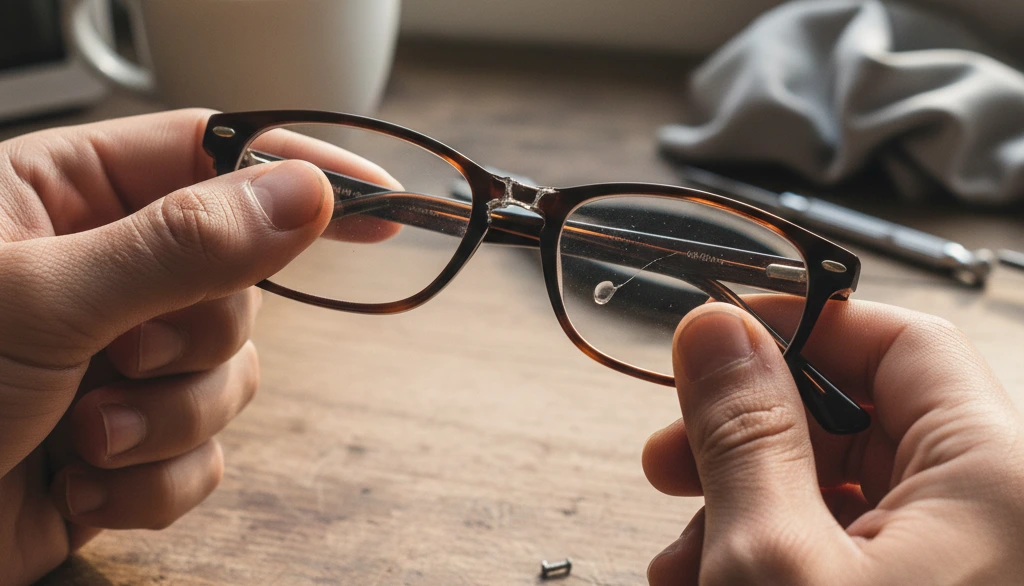
1. The Mystery of the Crooked Frame
You clean your glasses.
You store them carefully.
You didn’t sit on them.
And yet… somehow… they still feel off.
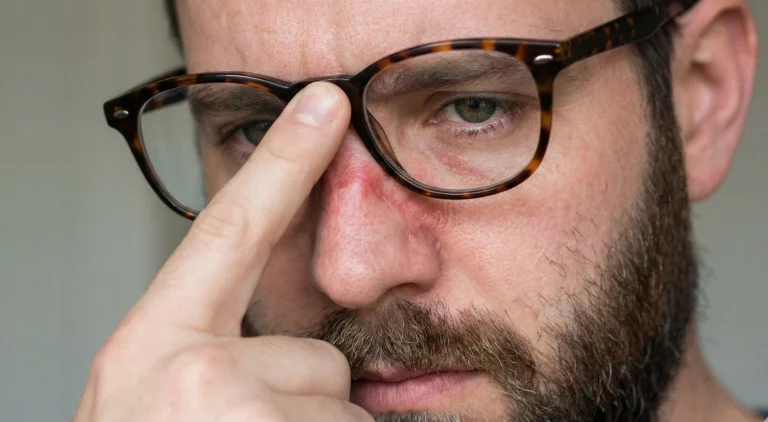
One temple presses harder than the other. The frame slides forward. The nose bridge doesn’t sit level anymore. You adjust it. Five minutes later, it’s crooked again.
Most people blame their face.
Some blame cheap frames.
A few assume it’s “just normal.”
It’s none of those.
What you’re experiencing is frame fatigue a slow, mechanical breakdown caused by daily habits that ruining your glasses frame.
Let’s be clear about something important right away:
This is not a vision problem.
This is not an eye issue.
This is purely a hardware failure.
Every frame whether it’s acetate, titanium, TR90, or carbon fiber is designed to hold a specific geometric shape. That shape keeps the frame balanced, symmetrical, and comfortable. Once that geometry starts drifting, your glasses feel wrong even if they look fine.
Think of your frame like a precision tool, not a fashion accessory.
A tool that lives on your face, absorbs sweat, heat, pressure, and movement all day long.
And just like any engineered object, it doesn’t usually fail in one dramatic moment.
It fails slowly.
Through habits you repeat every single day without realizing they’re doing damage.
This guide breaks down the five most common daily habits that ruin frame alignment, explains the physics behind the damage, and shows you how different frame materials respond to that stress.
If your glasses:
- feel crooked
- sit unevenly
- loosen too fast
- lose grip over time
This article will explain exactly why and how to stop it.
2. The Physics of Frame Alignment
Before we talk about bad habits, you need to understand how a frame actually stays aligned.
The Optical Triangle (Frame Geometry 101)
Every properly aligned frame rests on three contact points:
- The bridge
- The left ear contact point
- The right ear contact point
Together, these form what stylists call the optical triangle.
If even one of these points shifts:
- Weight distribution changes
- Pressure becomes uneven
- The frame rotates or slides
Your face didn’t change.
The triangle did.
Before you attempt to re-align your frames, make sure the frame geometry matches your Face Shape and Proportions to ensure the optical triangle is stable from the start.
Pantoscopic Tilt (Physical, Not Visual)
Pantoscopic tilt refers to the forward angle of the frame front relative to the temples.
When frames warp:
- One side tilts more forward than the other
- The frame front no longer sits parallel to your face
This creates:
- Sliding
- Nose pressure
- A “leaning” sensation
Even a 1–2° shift is noticeable in daily wear.
Vertex Distance (Hardware Shift)
Vertex distance is simply how far the frame front sits from your face.
Bad habits can:
- Push the frame front closer on one side
- Pull it away on the other
This creates:
- Uneven weight
- A floating or digging feeling
- Constant micro-adjusting
Again this is mechanical deformation, not a comfort or fit myth.
Frames don’t magically lose alignment.
They are pushed there habit by habit.
Now let’s talk about the habits doing the damage.
3. Habit #1: One-Handed Removal
This is the #1 silent killer of frame alignment.
You grab one temple.
You pull.
You’re done.
It feels harmless. It’s fast. Everyone does it.
The Leverage Effect
When you remove glasses with one hand:
- One hinge opens
- The other resists
- The bridge becomes a torsion point
This creates rotational stress across the frame front.
Over time:
- One hinge loosens faster
- One temple flares outward
- The frame front twists microscopically
Do this daily, and your frame will always drift out of alignment.
Spring Hinges vs. Standard Barrel Hinges
Standard Barrel Hinges
- Designed for straight opening and closing
- Hate lateral force
- Loosen permanently when twisted
Spring Hinges
- Absorb short-term stress better
- Hide damage longer
- Fail suddenly when the spring weakens
Spring hinges don’t prevent damage.
They delay your awareness of it.
The Solution: The Symmetrical Pull
Pro stylists teach one rule:
Both hands. Always.
- Grip both temples near the hinge
- Pull straight forward
- No twisting, no angle
It keeps hinge stress equal and preserves the optical triangle.
GlaSight Pro Tip:
If one side of your frame always loosens first, this habit is already costing you alignment.
4. Habit #2: The “Headband” Stretch
Wearing glasses on top of your head feels convenient.
Mechanically? It’s a disaster.
Cranium Width vs. Frame Width
The average adult head is wider at the temples than where glasses are designed to sit.
When you push frames upward:
- Temples spread beyond their neutral width
- The frame front flattens
- The hinge angle changes
This is not temporary.
Material Memory (Why Frames Don’t Bounce Back)
Acetate & TR90
- Have plastic memory
- Repeated stretching resets their “default” shape
Metal Frames
- Slowly widen at the bridge
- Lose temple curvature
The result:
- Glasses slide
- Grip weakens
- Alignment feels unstable
Why This Habit Is Worse Than Dropping Glasses
Dropping glasses is accidental.
Head-stretching is repetitive deformation.
Frames don’t fail from one big event.
They fail from thousands of small ones.
If your glasses feel loose even after an alignment check, use our Interactive Frame Fit Finder Tool to see if you are wearing a frame that is physically too wide for your temple measurements.
GlaSight Pro Tip:
If your glasses only feel loose after a few months, head-stretching is usually the culprit.
5. Habit #3: Thermal Expansion & Bathroom Ruining Your Glasses Frame
Bathrooms are hostile environments for eyewear.
Steam.
Humidity.
Heat spikes.
All terrible for precision hardware.
Thermal Expansion Explained Simply
Different frame components expand at different rates:
- Acetate expands faster than metal screws
- Hinges loosen as materials shift
- Micro-gaps form
You don’t see it.
But screws feel looser over time.
Humidity & Acetate Cloudiness
High moisture environments:
- Pull oils from acetate
- Dull the surface finish
- Cause clouding or whitening
This isn’t dirt it’s surface degradation.
Micro-Climates Matter
A bathroom isn’t one environment. It has:
- Hot zones (near showers)
- Cool zones (near tiles)
- Rapid temperature cycling
That cycling stresses:
- Screws
- Coatings
- Frame curvature
Rule:
If steam fogs mirrors, it’s stressing your frame.
Store glasses somewhere dry and stable. Always.
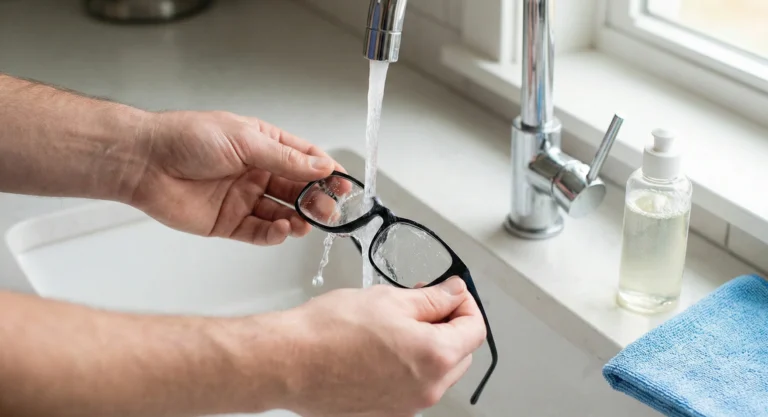
6. Habit #4: Incorrect Cleaning Pressure Ruining your Glasses Frame Alignment
Cleaning glasses shouldn’t bend them but many people make it happen.
The Bridge Snap Point
Holding the frame by the bridge while scrubbing:
- Forces pressure inward
- Creates a flex point at the nose bridge
- Warps the frame front
Especially dangerous with:
- Thin acetate
- Lightweight metal frames
Correct Mechanical Holding Technique
Always:
- Hold the frame with two hands
- Support both sides of the frame front
- Clean gently no twisting motion
Pro Tip:
If your frame looks straight but feels twisted, aggressive cleaning is often the reason.
7. Habit #5: Helmet & Headwear Conflict
Motorcycle riders and athletes this one’s for you.
The “Peak Shape” Effect
Helmet padding:
- Presses temples inward
- Forces the frame front upward
- Creates a peaked distortion
Repeated helmet use:
- Permanently bends temples
- Misaligns hinge angles
Why Riders Feel It More
- Tight padding
- Constant pressure
- Heat buildup
Frames aren’t designed for compression zones.
GlaSight Pro Tip:
Use helmet-compatible frames with thinner temples or remove glasses after loosening the helmet.
8. Material Science Deep Dive
Mazzuchelli Acetate
- Luxurious
- Heat-reactive
- Needs careful handling
Titanium
- Lightweight
- Strong but unforgiving
- Bends stay bent
TR90
- Flexible
- Loses memory over time
- Hides damage until it’s severe
Memory Metal
- Recovers shape
- Hinges still fail
- Not immune
Carbon Fiber
- Ultra-rigid
- Snaps instead of warps
- Alignment must be perfect
Material choice doesn’t eliminate bad habits it just changes how damage appears.
Heavy lenses put more strain on the bridge during thermal expansion. Check out our Lens Thickness Appearance Guide Tool to see how choosing high-index materials can reduce the physical weight and stress on your frame’s chassis.
9. Take Control of Your Frame
If your glasses feel off, don’t blame your face.
Check:
- Temple symmetry
- Hinge resistance
- Frame width vs. head width
Use digital measurement tools, compare left vs. right pressure, and change the habits before replacing the frame.
Proper habits save your frames, but a bad purchase can’t be fixed by habits alone. Read our deep-dive on the 5 Biggest Mistakes People Make When Buying Glasses Online to ensure your next pair is engineered for success.
Your glasses aren’t fragile.
They’re just engineered and engineering has rules.
Break the habits, and your frame stays aligned.
Ignore them, and no material can save it.
Frequently Asked Questions (FAQs)
Why do my glasses feel crooked even though they look straight
Most alignment issues are tactile before they are visual. A slight twist in the frame front or uneven hinge tension can shift pressure without being obvious in a mirror. The optical triangle may be distorted even if the frame appears symmetrical.
How fast can daily habits ruin frame alignment
Inconsistent handling can start affecting alignment within weeks. One handed removal, head stretching, and helmet pressure create cumulative stress. Damage usually becomes noticeable within two to three months of daily repetition.
Are expensive frames less likely to lose alignment
Higher priced frames often use better materials and hinges, but they still follow the same mechanical rules. Poor handling habits will deform premium frames just as reliably, sometimes more slowly but not permanently protected.
Can frame alignment fix itself over time
No. Frames do not self correct. Once materials shift or hinges loosen, the new position becomes the default. Without proper adjustment or habit change, alignment will continue to degrade.
Why does one side of my glasses always feel looser
This almost always points to asymmetric stress. Common causes include one handed removal, sleeping with glasses nearby, or favoring one side when placing frames on the head or desk.