

Samsung Smart Glasses 2026 vs Meta Ray-Bans Who Wins in Ai
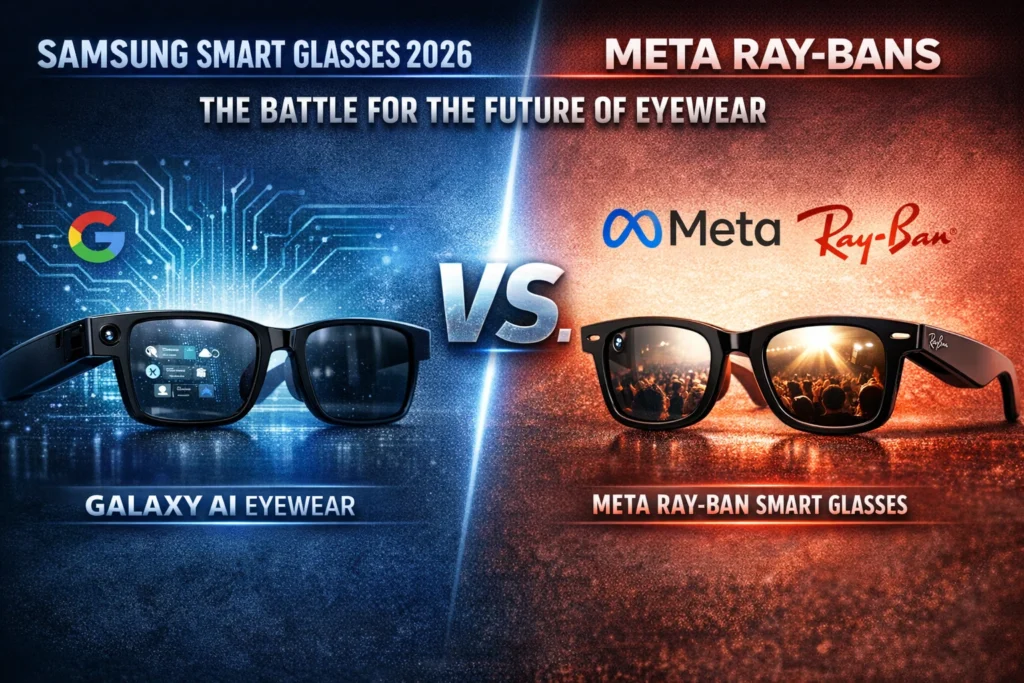
Samsung’s Galaxy Smart Glasses vs. Meta Ray-Bans (2026): Can Android XR Finally Beat the Cool Factor?
Samsung is preparing to enter the smart-glasses race in 2026 and this time, it’s not just about technology.
It’s about style, AI, and whether anyone can truly challenge the dominance of Meta’s Ray-Ban partnership.
Because the real question isn’t who has better specs.
The real question is:
Can Samsung make smart glasses look as good as Ray-Bans… while doing far more?
Welcome to the biggest wearable face-off of 2026.
Why Smart Glasses Suddenly Matter Again
For years, smart glasses lived in the category of interesting but unnecessary.
They were either too bulky, too experimental, or too obviously “tech.”
But something changed.
Three forces quietly reshaped the entire category:
- AI became useful in daily life
- Wearables shifted toward invisible design
- Consumers accepted cameras and audio in eyewear
Now, instead of asking why would I wear smart glasses?
people are asking:
Which smart glasses should I buy?
That shift is exactly why Samsung’s upcoming Galaxy smart glasses are generating so much search momentum going into 2026.
Samsung Smart Glasses 2026: What We Know So Far
Samsung hasn’t revealed everything publicly, but credible reports point to a device internally labeled SM-O200, built around Android XR and deeply connected to Galaxy AI features.
Even before launch, interest in Samsung smart glasses 2026 is climbing fast clear evidence that the market is ready for a serious competitor to Meta.
Expected Core Direction
Rather than building a flashy futuristic headset, Samsung appears focused on:
- Normal-looking frames
- Powerful on-device AI
- Tight Android ecosystem integration
- Hands-free everyday usefulness
In simple terms:
Less gadget. More lifestyle.
And that’s exactly where Meta found success.
The Benchmark: Why Meta Ray-Ban Smart Glasses Still Lead
Before Samsung can win, it has to beat the current reference point:
Meta’s Ray-Ban smart glasses.
Their success didn’t come from raw technology.
It came from something much harder:
They look cool.
That single factor solved the biggest historical problem of smart eyewear—
people refused to wear something that looked strange.
What Made Meta Ray-Bans Work
- Familiar Ray-Ban frame designs
- Built-in camera that feels natural to use
- Open-ear audio for music and calls
- Easy social media sharing
- Lightweight, everyday comfort
Most importantly:
They feel like sunglasses first, technology second.
Any competitor including Samsung must match this emotional comfort before specs even matter.
The 12MP Camera Battle: Capture vs. Convenience
One of the most discussed rumored features of Samsung’s glasses is a 12-megapixel camera designed for quick, first-person capture.
That immediately places Samsung in direct comparison with Meta’s camera-equipped frames.
But the real difference may not be image quality.
It may be intelligence.
Enter Gemini: The AI Advantage Samsung Is Betting On
Samsung’s biggest weapon isn’t hardware.
It’s deep AI integration powered by Google’s Gemini ecosystem.
Instead of glasses that only:
- take photos
- record video
- play audio
Samsung appears to be building glasses that can:
- understand what you’re seeing
- respond conversationally
- assist in real time
- connect seamlessly with Android apps
This shifts smart glasses from camera accessory to AI companion.
And that’s a far bigger category.
Galaxy AI Eyewear: From Gadget to Assistant
The phrase Galaxy AI eyewear signals Samsung’s real ambition.
Not just smart glasses.
Context-aware wearable intelligence.
Imagine glasses that can:
- summarize what you’re looking at
- translate text instantly
- guide navigation quietly
- answer spoken questions naturally
No phone screen.
No typing.
Just presence and voice.
That’s the experience Samsung appears to be chasing.
And if executed well, it could redefine the category.
Design Is the Real Battlefield
Technology alone will not decide this race.
Fashion will.
Meta understood this early by partnering with Ray-Ban.
Samsung seems to be responding with rumored collaborations involving high-end fashion eyewear brands such as Gentle Monster.
The goal is clear:
Make the technology invisible.
Because once smart glasses look identical to premium eyewear,
the psychological barrier disappears.
And adoption accelerates fast.
Can Samsung Match Ray-Ban’s Cultural Cool?
This is the most important question of the entire face-off.
Not battery life.
Not megapixels.
Not processors.
Cool.
Ray-Ban carries decades of cultural credibility music, film, street style.
Samsung must build that emotional trust almost overnight.
A fashion partnership helps.
AI innovation helps.
Android ecosystem reach helps.
But cultural cool is earned slowly.
That tension makes 2026 fascinating.
Smart Glasses With Camera: Privacy vs. Practicality
Search interest around glasses with camera and smart glasses with camera keeps rising, which shows growing curiosity but also concern.
Consumers now evaluate smart eyewear across two emotional questions:
Is this useful?
Is this socially acceptable?
Meta answered with subtle recording indicators and familiar design.
Samsung will need similar clarity to gain trust.
Because in wearables, comfort is psychological before physical.
Where Apple Fits Into the 2026 Smart Glasses Story
No smart-glasses conversation is complete without mentioning Apple smart glasses rumors.
Even without a confirmed product, Apple’s potential entry shapes the market by:
- raising design expectations
- emphasizing ecosystem integration
- pushing competitors toward polish
Samsung’s 2026 move may partly be strategic timing
enter strongly before Apple arrives.
Why Search Trends Signal a Real Market Shift
Rising interest in:
- Samsung smart glasses 2026
- sports glasses
- glasses with camera
- rimless glasses for men
reveals something deeper than curiosity.
It shows eyewear becoming multifunctional again.
Not just vision.
Not just fashion.
Digital interface.
And once eyewear becomes interface,
the category becomes enormous.
Meta vs. Samsung: Two Philosophies of Smart Glasses
Meta’s Approach
- Social sharing first
- Camera-driven storytelling
- Lifestyle simplicity
- Proven fashion partnership
Samsung’s Expected Approach
- AI-first intelligence
- Deep Android integration
- Context awareness
- Premium fashion collaboration
One sells experience.
The other may sell capability.
The winner will blend both.
The Hidden Factor: Everyday Usefulness
The real test of smart glasses is simple:
Do people keep wearing them after the first week?
Success depends on:
- comfort for hours
- battery that lasts a day
- features used daily, not occasionally
- design that fits every outfit
Whichever company solves daily habit formation wins the decade.
2026 Prediction: The Beginning of Invisible Computing
Smart glasses are not just another gadget category.
They are the early stage of something bigger:
computing that disappears into the real world.
No screens in your hand.
No constant notifications.
Just subtle assistance when needed.
Samsung’s Gemini-powered direction suggests
this future is arriving faster than expected.
Final Verdict: Can Samsung Beat Meta Ray-Bans?
Here’s the honest answer:
Technically? Very possible.
Culturally? Much harder.
To truly win, Samsung must deliver:
- Ray-Ban-level style
- Meta-level simplicity
- Gemini-level intelligence
If all three align,
2026 could mark the moment smart glasses shift from niche gadget
to everyday essential.
And if that happens,
this face-off won’t just define a product launch.
It will define the next era of personal technology.