
Why Do Your Glasses Look Weird in Photos? 7 Hidden Causes
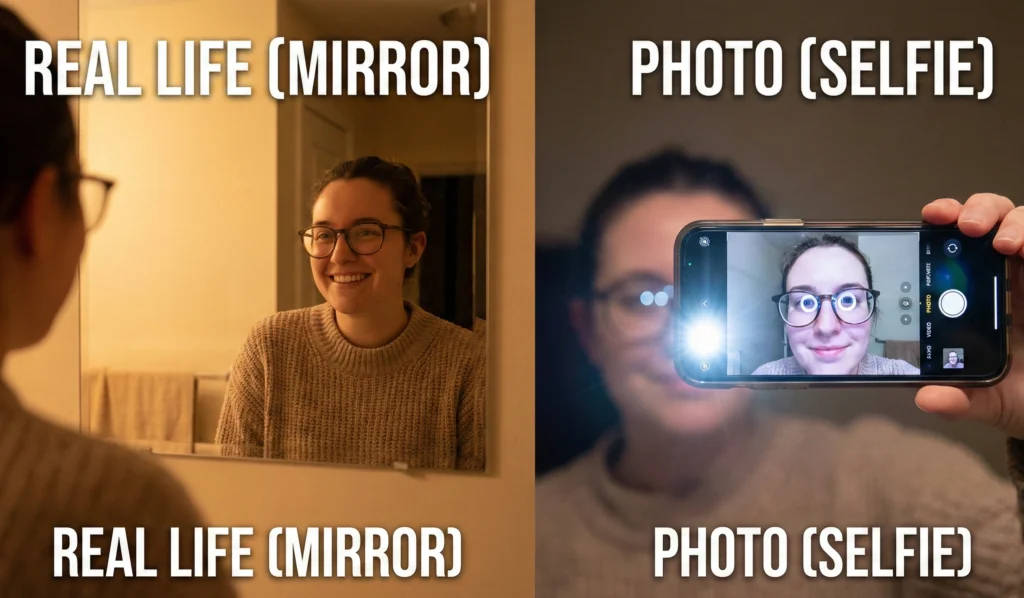
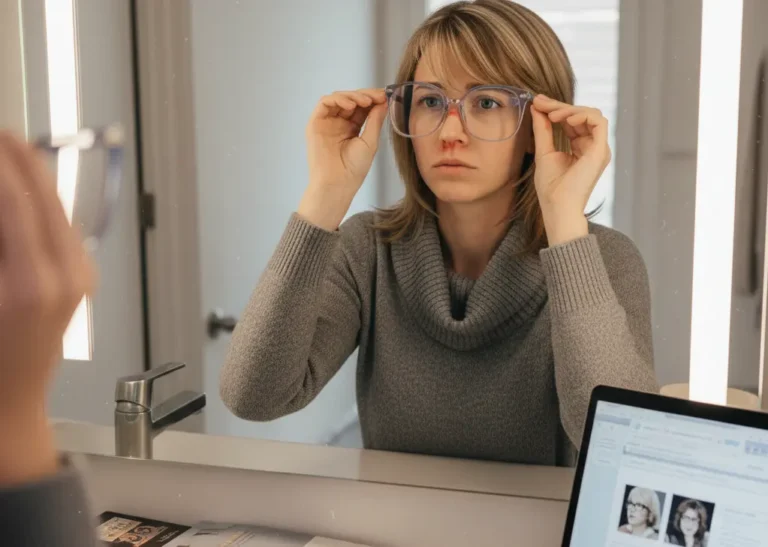
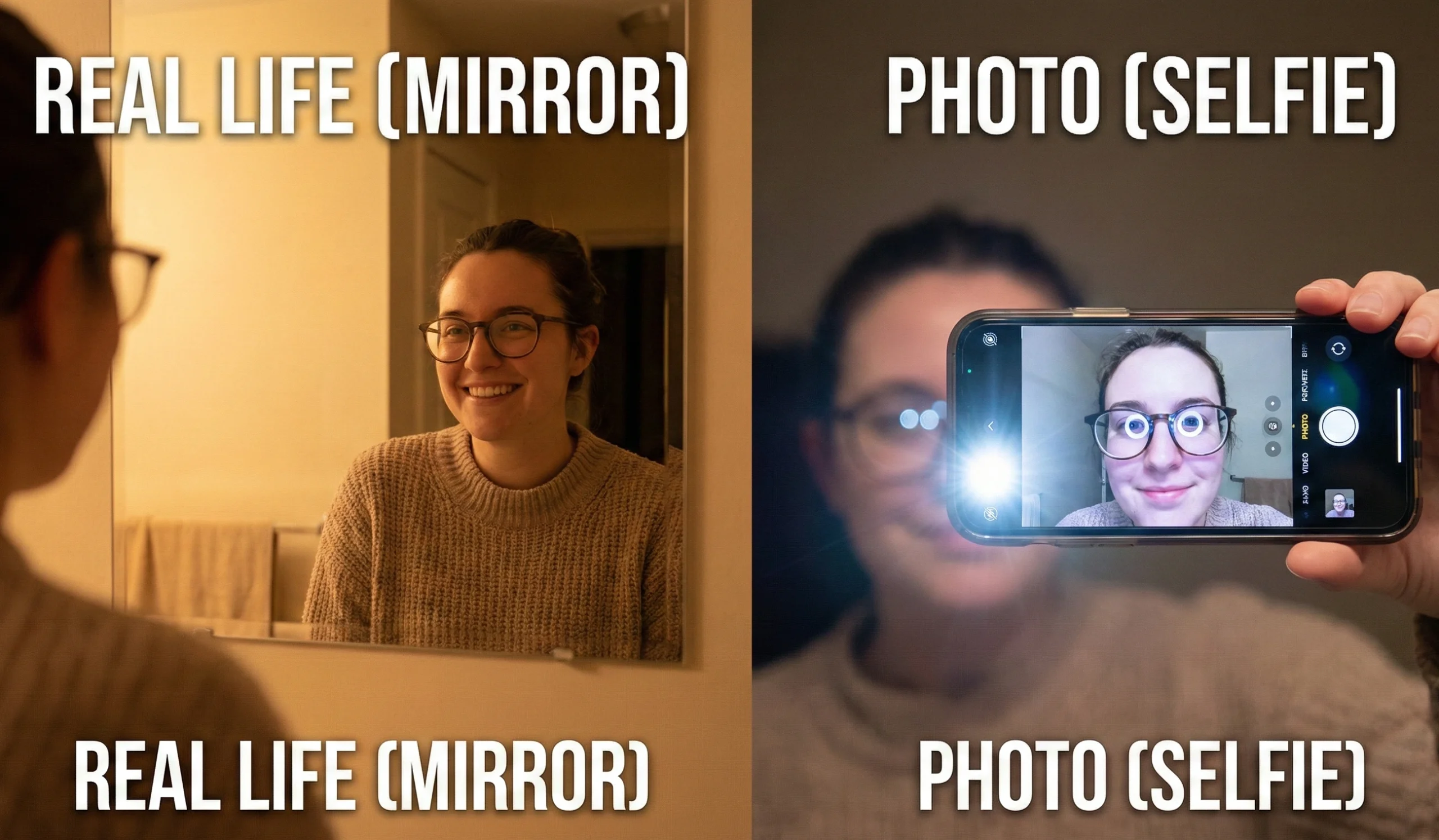
If you’ve ever looked in the mirror and thought your glasses looked perfectly fine—only to see a photo later and think “Why do they look so weird?” you’re not imagining things.
In real life, your glasses feel balanced. Your eyes look normal. The frames sit right.
But in photos, something feels off. Lenses look thicker. Reflections appear out of nowhere. Frames look crooked or oversized. Sometimes your eyes even look a different size.
This disconnect is incredibly common, and it frustrates a lot of people who otherwise love their glasses.
The good news?
This usually has nothing to do with your glasses being “bad.”
It happens because cameras and human vision see the world in completely different ways.
Once you understand why, the difference between photos and real life starts to make a lot more sense and becomes much less annoying.
The “Camera Effect”
- Cameras Freeze Reality: Your eyes adapt to reflections and movement; cameras lock them in place, making them look worse.
- Selfie Distortion: Phone cameras use wide-angle lenses that artificially widen your face and make glasses look larger.
- Lighting is Static: In real life, you move your head to dodge glare. In photos, the flash or window light hits the lens directly.
- The Mirror is More Accurate: Mirrors reflect 3D reality closer to what human eyes see. Trust the mirror, not the selfie.
- Solution: Use high-quality Anti-Reflective (AR) coatings and avoid rimless frames if you appear on video calls often.
Your Eyes Adapt. Cameras Don’t.
The most important thing to understand is this:
Human vision is adaptive. Cameras are not.
Your eyes and brain work together constantly to adjust for:
- lighting changes
- reflections
- distance
- movement
- angles
Your brain smooths out imperfections automatically. Small reflections disappear. Minor distortions are ignored. Uneven angles barely register.
A camera doesn’t do any of that.
A camera freezes a single moment from a single angle, under fixed lighting conditions, and records everything exactly as it appears—no filtering, no correction, no forgiveness.
That difference alone explains most of the “why do my glasses look strange in photos?” problem.
1. Reflections Become Permanent in Photos
In real life, reflections on glasses are fleeting.
You move your head slightly.
The light changes.
The reflection disappears.
Your brain barely registers it.
In photos, reflections are locked in.
Bright objects commonly reflected in lenses include:
- windows
- phone screens
- ring lights
- overhead LEDs
- lamps
When a camera captures these reflections, they become sharp, obvious, and distracting. What felt subtle in real life suddenly looks intense.
This is why glasses often look:
- shiny
- mirror-like
- reflective in selfies or video calls
And why reflections feel much worse on camera than in person.
article: “Why Premium Lenses Feel Different“ (focusing on the AR section).
2. Phone Cameras Distort Proportions
Most people take photos with their phones, especially front-facing cameras. These cameras use wide-angle lenses, and wide-angle lenses distort reality.
Wide-angle distortion:
- enlarges objects closer to the camera
- shrinks objects farther away
- exaggerates depth
Your glasses sit closer to the camera than your ears, cheeks, or hairline. So the camera makes them look:
- wider
- thicker
- more dominant
This distortion doesn’t exist in real life—but it shows up clearly in photos.
That’s why glasses can look oversized or bulky even when they fit perfectly.
article: “How to Hide Thick Lenses: 7 Rules for High Prescriptions“.
3. Lens Thickness Is Emphasized on Camera
If you have a moderate to strong prescription, lens thickness is another big factor.
In real life:
- your brain ignores edge thickness
- you rarely view your face from sharp side angles
- movement softens the appearance
In photos:
- the lens edge is frozen
- side profiles are emphasized
- contrast between frame and lens edge increases
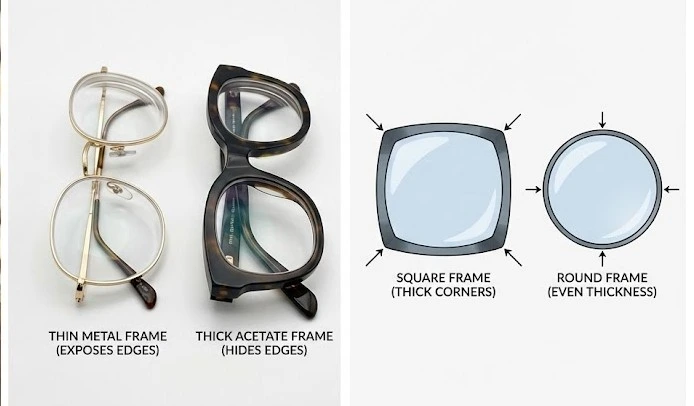
Thin frames or clear frames make this effect worse because there’s nothing hiding the lens edge.
So even lenses that look fine day-to-day can suddenly look thick in photos.
4. Lighting Is Fixed in Photos, Not in Real Life
In real life, light moves as you move.
In photos, light is fixed.
That difference matters more than most people realize.
Common photo lighting setups include:
- phone flash directly facing the lenses
- ring lights positioned at eye level
- bright windows behind the camera
- overhead LEDs
These setups create direct, flat reflections on lenses that don’t normally sit in your line of sight.
That’s why glasses can look fine indoors but terrible in selfies or video calls.
5. Screen and Blue Reflections Are Amplified
Many lenses reflect blue or purple hues under artificial light.
In person:
- reflections feel mild
- your brain filters them out
On camera:
- blue reflections look intense
- lenses appear shiny or tinted
This is especially noticeable during:
- video calls
- selfies
- indoor photography
Lower-quality coatings tend to exaggerate this effect, but even good lenses can reflect more on camera than in real life.
6. Your Eyes Can Look Smaller or Bigger
Prescription lenses bend light. Cameras don’t compensate for that.
Depending on your prescription:
- minus lenses can make eyes appear smaller
- plus lenses can make eyes appear larger
In real life, your brain adjusts instantly and ignores the distortion. In photos, the distortion is frozen.
This is why your eyes can look different in photos even when your glasses fit perfectly and feel comfortable.
7. Small Fit Issues Become Obvious
Minor alignment issues are easy to ignore in real life.
Photos don’t ignore them.
Cameras highlight:
- slight frame tilt
- uneven nose pads
- crooked temples
- frames sitting too high or low
These issues may be invisible during daily wear but stand out in still images.
That’s why glasses can suddenly look “off” in pictures even if they feel fine.
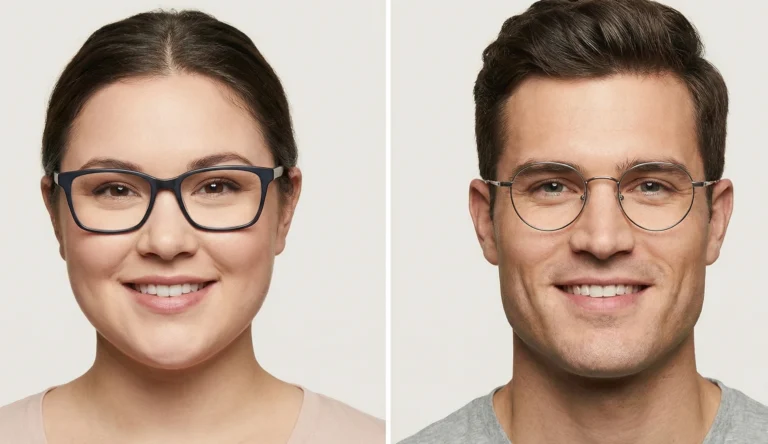
Sometimes the distortion isn’t the camera it’s the frame shape. If you aren’t sure which style fits you, check our 2026 Face Shape Guide to find your perfect match.
8. Contrast Is Increased Automatically
Cameras increase contrast by default.
This makes:
- dark frames look darker
- light lenses look lighter
- lens edges stand out more
Clear or transparent frames suffer the most because they offer no visual separation between lens and face.
What looks subtle in person becomes obvious on camera.
9. Photos Flatten Depth
Real life has depth. Photos flatten it.
This makes:
- frames look closer to your face
- lenses appear thicker
- facial proportions feel different
Depth flattening removes the natural spacing your eyes perceive, which helps glasses look balanced in person.
10. Why Video Calls Are the Worst Case Scenario
Video calls combine every problem at once:
- fixed camera angle
- wide-angle lens
- screen light
- ring lights
- constant reflections
That’s why glasses often look worse on Zoom or FaceTime than in real life.
Your glasses didn’t change. The environment did.
Why This Is Normal (And Not a Glasses Failure)
This is important to understand:
Photos exaggerate what real life smooths out.
Your glasses didn’t suddenly become worse.
Your prescription didn’t change.
Your face didn’t change.
The camera simply isn’t designed to see the way humans do.
Once you understand this, the frustration eases and you stop blaming your glasses for something they didn’t do.
How to Make Glasses Look Better in Photos
You can’t eliminate the difference entirely, but you can reduce it.
Choose Frames Wisely
- Avoid ultra-thin or rimless frames if photos matter
- Slightly thicker frames hide lens edges
- Darker colors reduce contrast
Improve Lens Coatings
- High-quality Anti-Reflective coatings reduce visible glare
- Cheap coatings reflect more light on camera
Adjust Camera Position
- Hold the camera slightly higher than eye level
- Step back and zoom instead of close-up selfies
- Avoid extreme angles
Control Lighting
- Avoid direct light hitting lenses
- Position lights slightly above or to the side
- Reduce screen brightness during selfies
Why Mirrors Are More Trustworthy Than Photos
Mirrors show you what people actually see.
Photos show what cameras see.
Those two things are not the same.
If your glasses:
- feel comfortable
- look balanced in person
- don’t distract you during daily wear
then they’re doing their job.
A single unflattering photo doesn’t cancel that.
The Psychological Effect of Seeing Yourself in Photos
Seeing yourself in photos is already uncomfortable for many people. Glasses amplify that feeling because they introduce reflections, distortion, and asymmetry.
When something looks different than expected, the brain assumes something is wrong even when it isn’t.
Understanding the technical reasons behind this difference helps separate perception from reality.
Real-Life Wear Matters More Than Camera Appearance
It’s easy to obsess over photos, especially in a world full of selfies and video calls.
But glasses are worn in real life, not frozen frames.
Comfort, balance, and daily usability matter far more than how lenses behave under artificial lighting and wide-angle cameras.
Final Thought
Your glasses don’t actually look worse in photos.
Photos exaggerate what real life gently hides.
Cameras don’t adapt.
Your eyes do.
Once you understand that difference, the strange reflections, thickness, and proportions stop feeling like a personal failure and start looking like a technical one.
If your glasses feel right and look good in the mirror, trust that more than a single image on a screen.
Because photos capture light.
Your eyes experience it.
And those two things will never see the world the same way.
Frequently Asked Questions (FAQs)
Is it normal for glasses to look different in photos than in real life?
Yes. This is very common. Cameras capture reflections, distortion, and lighting exactly as they appear in one moment, while human vision continuously adapts and smooths those details out.
Why do my glasses look wider or bigger in selfies?
Most phone cameras use wide-angle lenses, especially the front camera. Wide-angle lenses exaggerate objects closer to the camera, which makes glasses appear wider or more dominant than they look in real life.
Why do reflections show up so strongly in photos?
In real life, reflections change as you move and your brain ignores them. In photos, reflections are frozen in place, making them look brighter and more noticeable.
Why do my lenses look thicker in pictures?
Photos emphasize lens edges, especially from side angles. Thin or clear frames make this more noticeable because there’s nothing hiding the lens edge, even if the lenses look fine in person.
Why do my eyes look smaller or bigger in photos with glasses?
Prescription lenses bend light. Cameras don’t compensate for that bending, so the effect becomes more obvious in photos than in real life.
Why do glasses look worse on video calls than in real life?
Video calls combine several problem factors at once: fixed camera angles, screen light, ring lights, and wide-angle lenses. Together, they exaggerate reflections and distortion.