

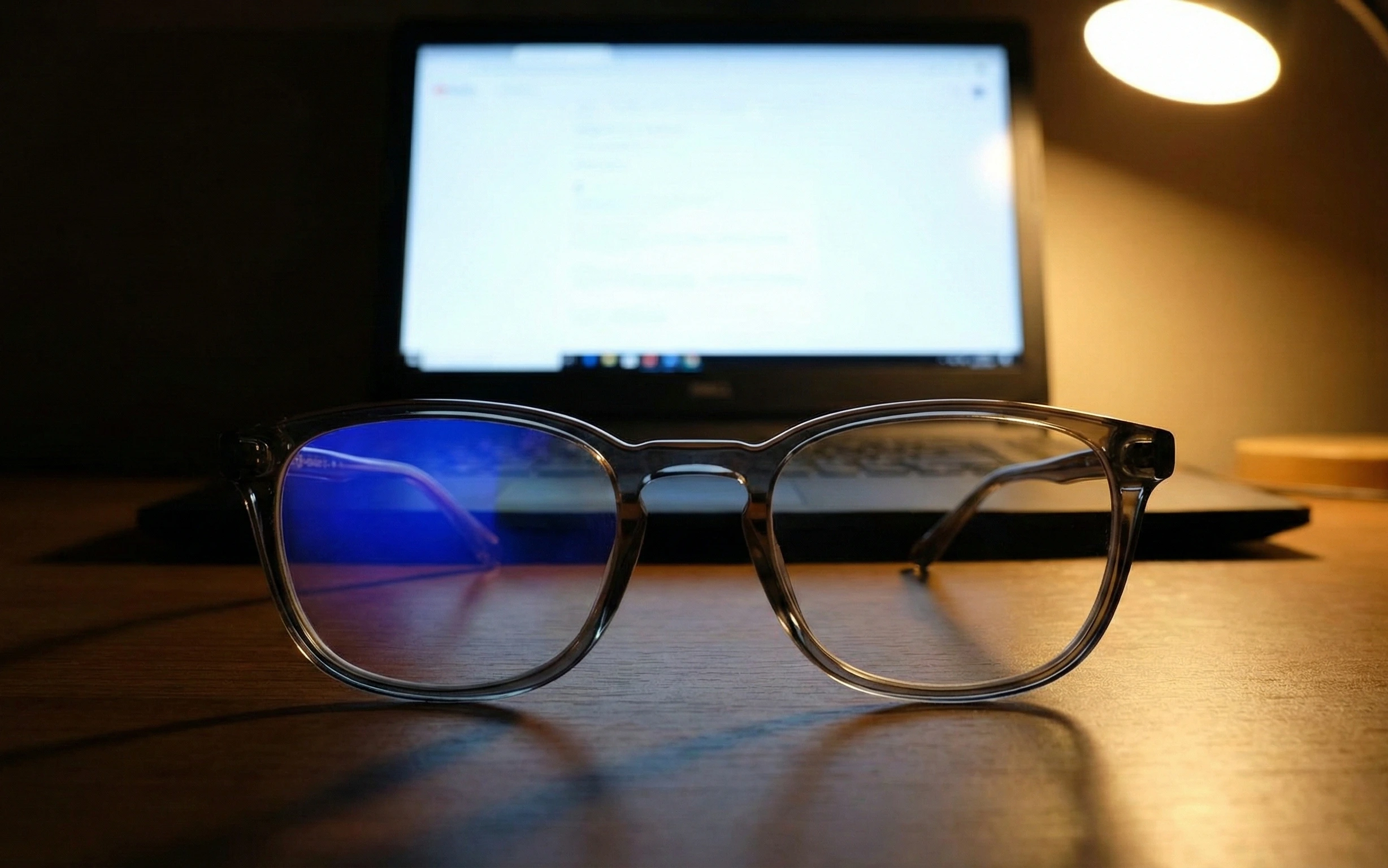
Anti-Reflective vs. Blue Light Blocking: 5 Things to Know
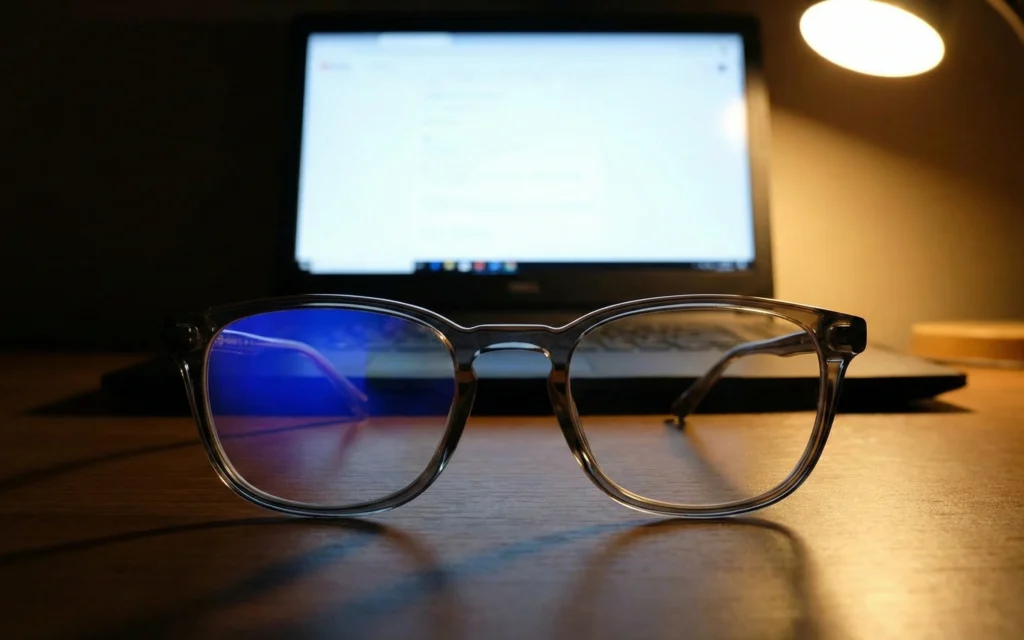
Introduction
I used to think buying glasses was simple. You walk into a store, pick a frame, they ask “Do you want blue light?” and you nod because… why not? I thought that was enough.
Then I started doing video calls for work, and suddenly I looked like a budget superhero with a glowing ring of light bouncing off my lenses. You couldn’t even see my eyes. That was my first clue that something was wrong.
At the same time, my eyes would start burning after a long day on my laptop. Not the dramatic “I need an eye doctor” pain more like a slow, annoying fatigue that made everything look slightly foggy by evening. And yes, I blamed the screen like everyone else does.
So I did what any normal person would do: I bought a cheap pair of “blue light glasses” from a local store.
They made everything worse.
The reflections were harsher, the glare was embarrassing, and the lenses had this weird blue tint that looked like a cheap Instagram filter. That is when I realized something the optical industry rarely explains: Anti-Reflective vs Blue Light Blocking, these are two completely different technologies, and you actually need them together to fix both clarity and comfort.
Most people buy lenses like they’re choosing toppings on a pizza one here, one there, whatever sounds useful. But with glasses, the combination matters far more than the individual feature. Once I switched to lenses that had both premium AR and a proper HEV (blue light) filter, the difference was instant. No more glare on camera, no more halos while driving, and no more evening eye fatigue.
This article isn’t a dictionary definition of coatings. You can find that on Wikipedia. This is the real explanation the one I wish someone gave me before I wasted money on the wrong upgrade.
Table of Contents
Why Standard Lenses Look Like Mirrors (And How AR Fixes It)
The first time I realized how bad standard lenses really are was during a night drive. I was on a dim road, and every oncoming car looked like it had a halo straight out of a sci-fi movie. The glare was so strong that I kept blinking just to refocus. At that moment, I understood why eye doctors always push Anti-Reflective (AR) coating it isn’t an upsell, it’s survival.
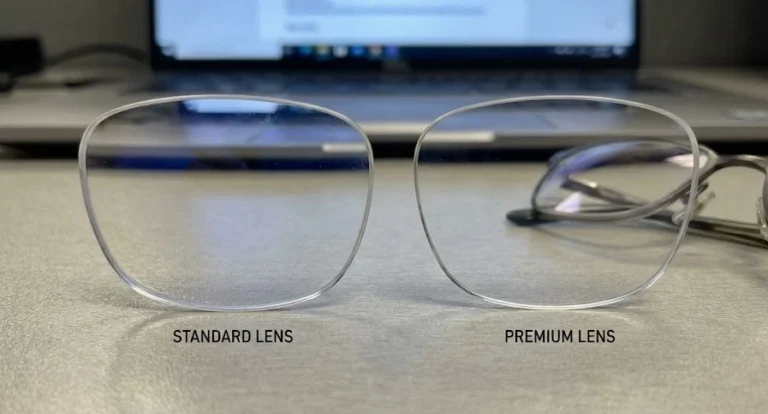
Here’s the part nobody tells you: Every “normal” lens reflects light like a tiny mirror.
Plastic lenses in particular bounce back about 8% of all the light that hits them. That may sound small, but your eyes feel every bit of it. That is why standard lenses feel grainy, slightly foggy, or harsh under bright lights. You notice it everywhere once you’re aware of it:
- Indoor LEDs creating white spots on your lenses.
- Headlights exploding into halos.
- Your computer screen reflecting right back into your coworkers’ faces on Zoom.
Before I switched to AR-coated lenses, I thought this was normal. I assumed everyone’s glasses turned into flashlights whenever a car passed by.
Anti-Reflective coating is the thing that fixes this. Not a little dramatically.
The first thing you see when you get AR is what you don’t see anymore: glare. People can actually see your eyes instead of a shiny reflection. Lights look cleaner. Screens become easier to look at. Even selfies stop looking like the flash is fighting with your glasses.
One moment sold me on AR forever: I took two photos, one with standard lenses and one with AR. In the first, I couldn’t see my eyes at all. In the second, my lenses looked almost invisible. Same lighting, same phone same place same type of frame the only difference was the coating.


That’s the effect you’re paying for. It’s not about “microscopic layers.” It’s about making your eyes visible, making light behave, and making your vision feel smoother in real life.
Read about: Why Do Your Glasses Look Weird in Photos?
The Truth About Blue Light Glasses (And Why Cheap Ones Don’t Work)
My first experience with blue light glasses was a complete disappointment. I bought a cheap pair because the reviews said things like “Great for computer work” and “My eyes feel so relaxed now.” Naturally, I believed the hype.
Five minutes into wearing them, I knew something was off.
The lenses had this weird blue shimmer that made them look like they were laminated in plastic wrap. Every time I turned my head, the reflection changed color blue, purple, blue again like a budget hologram sticker. I remember thinking, If this is supposed to make my eyes feel better, why does it look like a toy?
Here’s what I learned later: Most cheap blue light glasses block blue light by reflecting it straight off the surface.
That means instead of filtering the high-energy wavelengths gently, the lens literally bounces the blue light back which explains why the reflection looks like someone glued a tiny LED to the lens. And ironically, all that extra reflection makes screen glare worse.
No one tells you this on Amazon. The product description just says “Blocks blue light!” as if that solves everything from fatigue to insomnia. The reality is more nuanced.
After switching to a higher-quality lens with proper HEV filtering, the difference was noticeable within a day. My eyes didn’t feel as tight in the evening, the screen looked softer without looking yellow, and the constant “white glow” from bright backgrounds stopped punching my vision.
But here’s the catch: Blue light filtering alone won’t fix glare, halos, or that reflective blue shimmer.
That’s why so many people try blue light glasses and say, “These don’t work.” It’s not the concept that’s bad it’s the execution. From my experience, the right blue light filter should:
- Reduce harshness without tinting the world yellow.
- Make screens feel “calmer.”
- Work with your AR coating, not against it.
The biggest lesson? Blue light technology is a comfort upgrade, not a clarity upgrade. If you expect it to fix glare, you’ll hate it. If you pair it with good AR coating, you’ll wonder how you ever lived without it.
I Wore Both for a Week. Here is What Happened
Before writing this, I did something simple: I put two pairs of glasses on my desk one with AR coating only, and one with blue light filtering only. Then I spent a week switching between them while working, driving, and using my phone at night.
What I learned in that week is the reason this article even exists.
With only AR coating:
My screen looked incredibly sharp. Text looked like it was printed on paper. During Zoom calls, my lenses looked almost invisible. But after long hours on my laptop, my eyes still felt tired. Not painful, just that dull heaviness that creeps in around 6 or 7 PM.
With only Blue Light filtering:
This one surprised me. My eyes felt more relaxed, especially in the evening. But the glare? Wow. It was worse than I expected. The surface reflections were stronger, almost like the lens was saying, “Hey, look at me bounce this light around.” It made screens look cleaner but shinier the exact opposite of what I wanted for video calls.
Putting them side by side made one thing obvious:
These two technologies don’t compete. They complete each other. Imagine wearing headphones where one side gives you bass and the other gives you clarity. Separately? Weird. Together? Perfect.
Here is my clear winner for each scenario:
- Night Driving: AR wins. Without it, headlights explode into glowing circles.
- Long Laptop Sessions: Blue Light wins. It softens the harshness of white screens.
- Video Calls: AR wins. People can actually see your eyes instead of a glowing ring of light.
- Gaming: A combination is ideal. AR gives clarity; Blue Light gives comfort.
After the side-by-side test, it became painfully clear why so many people feel disappointed after buying standard blue light glasses: they expect them to fix clarity and comfort but they only fix half the problem.
Why the Combination Matters (The Synergy Nobody Explains)
If there’s one thing the optical industry consistently fails to explain, it’s this: AR coating and Blue Light filtering were never meant to be “either–or.”
I learned this the hard way after wasting money on a pair of “premium” blue light glasses that didn’t have AR. They blocked some blue light, sure, but the reflections were so bad that I ended up taking them off whenever I joined a video call. Every overhead light in the room showed up on my lenses like a spotlight.
That’s when I realized:
- Blue light filtering helps your eyes feel good.
- AR coating helps your eyes look good.
- You need both for your eyes to work well.
Here’s how I explain it to friends:
- Blue Light without AR = Buying gym shoes with no grip. Technically they “work,” but you’ll slip everywhere.
- AR without Blue Light = Buying shoes with amazing grip but no cushioning. Great traction, but you’ll feel every impact.
- Stack them together, and everything finally feels balanced.
This is why many premium optical brands quietly include AR as a default layer when applying blue light filters. They know one coating covers the weakness of the other. Once you wear a dual-coated lens, it’s very hard to go back. Your brain gets used to the clear vision and reduced strain, and suddenly every uncoated lens looks cheap and distracting.
The Reflection Test (How I Check Any Pair of Glasses in 5 Seconds)
Manufacturers love using fancy names for coatings. “HD Vision,” “Anti-Glare Plus,” “TrueBlue Filter”… half the time, you have no idea what you’re actually wearing. So I started using a simple test to figure out exactly what coating a lens has.
Step 1: Hold your glasses under a lamp or your phone flashlight. Step 2: Tilt them slightly until you catch a reflection. Step 3: Look at the color.
- If the reflection is bright WHITE: That’s a plain plastic lens. No AR, no blue light filter, nothing. This is the “default factory lens” that reflects light like a mirror. I used to wear these without realizing how much clarity I was losing.
- If the reflection is faint GREEN or PURPLE: That’s Anti-Reflective coating. This is what makes lenses look almost invisible in videos. Whenever I switch back to AR lenses after wearing standard ones, it feels like someone cleaned a window I didn’t know was dirty.
- If the reflection is distinctly BLUE: That’s Blue Light Filtering. This is easy to spot. Blue is literally being bounced off the lens. Cheap blue light lenses reflect a lot of blue it looks shiny and obvious. High-quality filters still show a blue hue, but it’s subtle. Not neon. Not fake.
When you can identify coatings instantly, you stop guessing and you start buying lenses that actually match your needs. It’s a small habit, but it has saved me from wasting money more than once.
Conclusion: Stop Choosing, Start Stacking
If there’s one thing I wish someone had told me years ago, it’s this: the quality of your lenses matters more than the frame you buy. Frames just sit on your face. Lenses decide how your entire day feels.
Anti-Reflective coating and Blue Light Filtering aren’t buzzwords. They fix two different problems that almost everyone with glasses deals with glare and strain. I learned this through trial and error, from driving at night with glaring halos to buying “blue light” glasses that only made my reflections worse.
Once I switched to lenses that combined both technologies, everything changed. My video calls looked cleaner, my eyes stopped burning after long screen sessions, and night driving felt normal again instead of stressful. It wasn’t a small difference. It was immediate.
That’s why I tell people this without hesitation: If you’re getting new glasses, don’t choose between AR and blue light filtering. Get both. That’s the setup that actually works in the real world. You’ll see the difference the moment you put them on and you’ll feel the difference at the end of the day.
If you want to try the exact combination I use now, check out our dual-coated lenses. They’re built with premium AR and true HEV filtering, and they’re the closest thing I’ve found to stress-free vision. Your eyes deserve that upgrade.
✨ Confused by Lens Coatings?
Don’t pay for coatings you don’t need. Use our interactive guide to find the perfect performance suite based on your daily screen time and environment.
Try the Lens Selection Tool →Frequently Asked Questions (FAQs)
Are Anti-Reflective coating and Blue Light filtering the same thing?
No. They solve different problems. Anti-Reflective (AR) coating reduces glare and reflections, while Blue Light filtering reduces exposure to high-energy light from screens. Many people confuse them, but they work best together, not as substitutes.
Why do my glasses reflect light so badly on video calls?
That usually means your lenses don’t have Anti-Reflective coating. Without AR, lenses act like small mirrors, reflecting ring lights, screens, and overhead lighting directly back into the camera.
If I already have blue light glasses, do I still need AR coating?
Yes. Blue light filtering alone doesn’t reduce glare or reflections. In some cases, cheap blue light lenses can actually increase visible reflections if AR coating isn’t applied on top.
Why do cheap blue light glasses look shiny or blue?
Many low-quality blue light glasses block blue light by reflecting it off the surface instead of filtering it through the lens material. This causes a strong blue or purple reflection that looks shiny and distracting.
What does a good blue light lens look like?
A high-quality blue light lens:
Doesn’t look neon blue
Has subtle reflections, not mirror-like glare
Softens screen harshness without turning everything yellow
Works alongside Anti-Reflective coating
Why do my eyes feel tired even though my screen looks clear?
Clear visuals don’t always mean visual comfort. AR coating improves clarity, but Blue Light filtering improves how long you can comfortably look at screens. Without both, you often fix only half the problem.
Can I add AR coating to existing blue light glasses?
In most cases, coatings are applied during lens manufacturing. If your current lenses lack AR, upgrading usually means replacing the lenses rather than adding a layer afterward.
Do I really need both AR and Blue Light filtering?
If you use screens daily, drive at night, or attend video calls, yes. AR improves how things look. Blue Light filtering improves how your eyes feel over time. Together, they provide the most balanced experience.


2 Comments