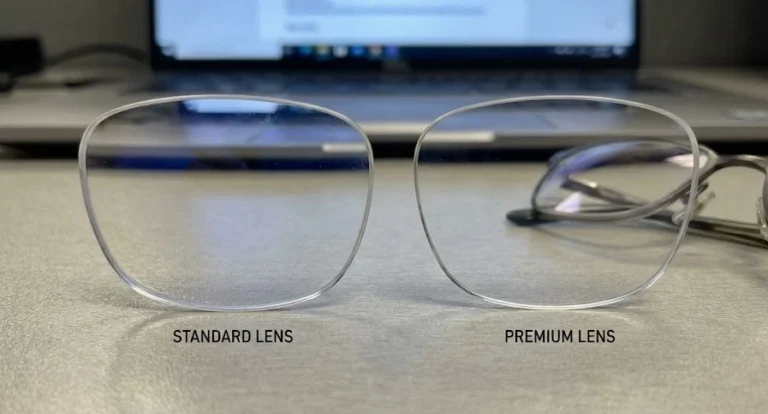

Why Lenses Get Scratched in Urban Areas (5 Best Expert Tips)
If you live in a city and wear glasses every day, this probably sounds familiar.
Your lenses were crystal clear when you bought them. You were careful. You didn’t throw them around. You cleaned them “properly.” And yet, within months, tiny scratches started appearing. At first, they were barely noticeable. Then one day, under bright light or while driving at night, you couldn’t unsee them and yourself why lenses get scratched so easily
Most people assume scratched lenses are caused by carelessness.
That assumption is wrong.
In reality, urban environments are unusually hostile to modern eyewear, and most wearers are never told why. This article explains what’s really happening to your lenses in cities, why modern lens materials scratch more easily than older ones, and what actually works to prevent damage long-term.
No myths. No fear tactics. Just how lenses behave in real life.
Table of Contents
The Urban Lens Problem Nobody Explains
Cities expose glasses to a completely different set of stresses than rural or low-density environments.
Urban air isn’t just “dirty.” It’s abrasive.
Microscopic particles from:
- Road dust
- Brake pads
- Construction debris
- Diesel exhaust
- Cement and silica
- Metal fragments
- Industrial pollution
float constantly in the air. You can’t see them, but they land on everything including your lenses.
When those particles mix with oil from your skin, humidity, and everyday cleaning habits, scratches become almost inevitable unless you understand how modern lenses work.
Why Lenses Scratched More Than Old Glass Lenses
Many people say, “My old glasses never scratched this easily.”
They’re not imagining it.
1. Modern Lenses Are Softer by Design
Most modern prescription lenses are made from:
- Polycarbonate
- Trivex
- High-index plastic
These materials are:
- Lightweight
- Impact resistant
- Safer than glass
But they are also softer than traditional glass lenses.
Softer materials bend instead of shattering good for safety, bad for surface durability.
Glass lenses resisted scratches because glass is naturally hard. Modern plastics rely on coatings for scratch resistance, not the base material.
2. Scratch-Resistant ≠ Scratch-Proof
This is one of the biggest misunderstandings in eyewear.
“Scratch-resistant” coatings:
- Reduce damage
- Slow scratching
- Protect against light abrasion
They do not prevent scratches entirely.
In urban environments, the abrasive load is simply too high for coatings alone to handle careless handling.
Urban Dust Is Not “Normal Dust”
Here’s where cities become the real problem.
Urban dust contains:
- Silica (from cement and concrete)
- Metallic particles (from brakes and construction)
- Carbon residue
- Micro-sand
Silica is the same material found in sandpaper.
So when you wipe your lenses dry even gently you’re often dragging micro sand across a soft surface.
That’s not cleaning.
That’s controlled abrasion.
The Most Common Lens-Damaging Habits (That Feel Harmless)
Most scratches don’t come from accidents.
They come from habits people think are safe.
1. Dry Wiping Lenses
This is the number one cause of lens damage in cities.
Dry wiping:
- Shirt sleeves
- Tissues
- Towels
- Paper napkins
Even microfiber cloths can scratch lenses if particles are already on the surface.
Urban dust + dry wiping micro scratches.
2. Cleaning Lenses Immediately After Coming Outside
When you step indoors from a street:
- Dust is fresh on your lenses
- Particles haven’t settled
- Oils are active
Wiping at this stage grinds debris into the coating.
Let lenses rest for a moment or rinse them first.
3. Pocketing Glasses Without a Case
Urban pockets are full of:
- Fabric fibers
- Dust
- Metal debris
- Keys and coins (even if not touching)
The friction alone damages coatings over time.
4. Face-Down Placement on Tables
Urban surfaces look clean. They aren’t.
Restaurant tables, office desks, counters all carry micro debris. One slide across a surface can do permanent damage.
Why the Experts Agree: The Science Behind Dr. Mandell’s Glass Cleaning Advice
Why City Living Accelerates Scratching
Let’s connect the dots.
In cities, you experience:
- More airborne particles
- More cleaning cycles per day
- More handling
- More exposure to artificial lighting (which makes scratches visible)
- More night driving (where scratches scatter light)
This combination makes scratches appear faster, even if damage occurred gradually.
Why Anti-Reflective (AR) Coatings Scratch First
Many people think the lens itself is scratched. Often, it’s the AR coating, not the lens.
AR coatings:
- Reduce glare
- Improve clarity
- Increase light transmission
But they are:
- Ultra-thin
- Multi-layered
- More sensitive to abrasion
Once AR is damaged, scratches look worse because light scatters inside the layers.
This is why scratched lenses feel “foggy” at night.
Read more: Many people confuse AR coatings with blue light filters. If you want to see which one is right for your daily routine, check out our guide: Anti-Reflective vs. Blue Light Blocking: 5 Things to Know Before Choosing.
The Urban Scratch Illusion
Here’s a subtle but important truth:
Urban lighting makes scratches more visible.
LED headlights, streetlights, office LEDs, and phone screens amplify:
- Micro abrasions
- Surface haze
- Coating wear
So even light scratches become distracting in cities compared to softer rural lighting.
Why Cheap Cleaning Sprays Make Things Worse
Not all lens cleaners are safe.
Some low-quality sprays:
- Contain alcohol concentrations too high
- Leave residue
- Weaken coatings over time
Repeated chemical stress makes AR layers brittle, increasing scratch risk.
The Real Way to Clean Lenses in Cities (Step-by-Step)
This matters more than any coating.
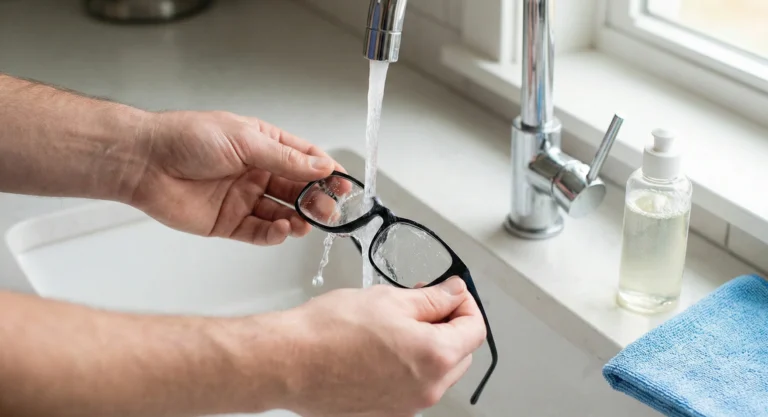
The Safe Urban Cleaning Method
- Rinse lenses with clean water
- Removes abrasive particles
- Apply a drop of lens-safe cleaner
- Or mild dish soap (once in a while)
- Gently rub with fingertips
- Never dry cloth first
- Rinse again
- Pat dry with clean microfiber
This reduces friction dramatically.
Why Microfiber Cloths Still Cause Damage
Microfiber isn’t magic.
Problems happen when:
- Cloths are reused without washing
- Dust builds into fibers
- Cloths are stored in pockets or bags
Dirty microfiber = fine sandpaper.
Wash cloths regularly and keep them sealed.
Storage Mistakes That Kill Lenses Slowly
Urban life involves constant movement.
Common storage issues:
- Tossing glasses into bags
- Leaving them in car consoles
- Keeping them on dashboards (heat damage)
- Open cases with dust inside
Heat weakens coatings. Dust scratches them.
Pro Tip: If you want a more detailed breakdown of the science behind safe maintenance, read our master guide: How to Clean Your Glasses Without Scratching Them.
Why “Hard Coating” Quality Matters More Than Brand
Two lenses can both say “scratch-resistant” and perform very differently.
What matters:
- Coating thickness
- Curing process
- Multi-layer bonding quality
Cheap lenses often cut corners here.
This is why some lenses last years and others don’t survive one summer.
The Role of Frame Design in Scratches
Frames influence how lenses contact surfaces.
Risky designs:
- Flat-front frames
- Thin rimless designs
- Frames with lens edges exposed
Safer designs:
- Slightly recessed lenses
- Protective bevels
- Balanced weight distribution
Design matters more in cities than style trends admit.
Why Urban Professionals Notice Scratches Faster
If you:
- Work on screens
- Drive at night
- Attend meetings under LED lights
You’ll notice scratches sooner.
Your visual environment highlights surface imperfections constantly.
What Actually Helps Prevent Scratches Long-Term
Let’s be practical.
What Works:
- Consistent rinsing before wiping
- Clean microfiber rotation
- Hard-coated AR lenses
- Protective storage habits
- Avoiding dry wiping at all costs
What Doesn’t:
- Being “extra careful” without changing habits
- Expensive frames alone
- Marketing labels
- Assuming coatings are permanent
Are Scratched Lenses Fixable?
Light surface haze:
- Sometimes reduced with professional polishing
- Often temporary improvement only
Deep scratches:
- Not safely repairable
- Polishing removes coatings
- Replacement is usually the only option
Prevention is far cheaper than replacement.
Why Urban Wearers Should Replace Lenses, Not Frames
Frames usually outlast lenses.
Replacing lenses:
- Restores clarity
- Keeps fit and comfort
- Costs less than full replacement
Many people replace entire glasses unnecessarily.
The Psychological Cost of Scratched Lenses
This is rarely discussed.
Scratched lenses cause:
- Visual fatigue
- Reduced contrast
- Night driving discomfort
- Subconscious eye strain
Your brain works harder to compensate, even if you don’t notice consciously.
Protecting Your Vision in the City (Read if you skip article)
- Urban Air is Abrasive: Dust in high-density cities often contains silica and metallic particles. Wiping these dry is essentially like using sandpaper on your lenses.
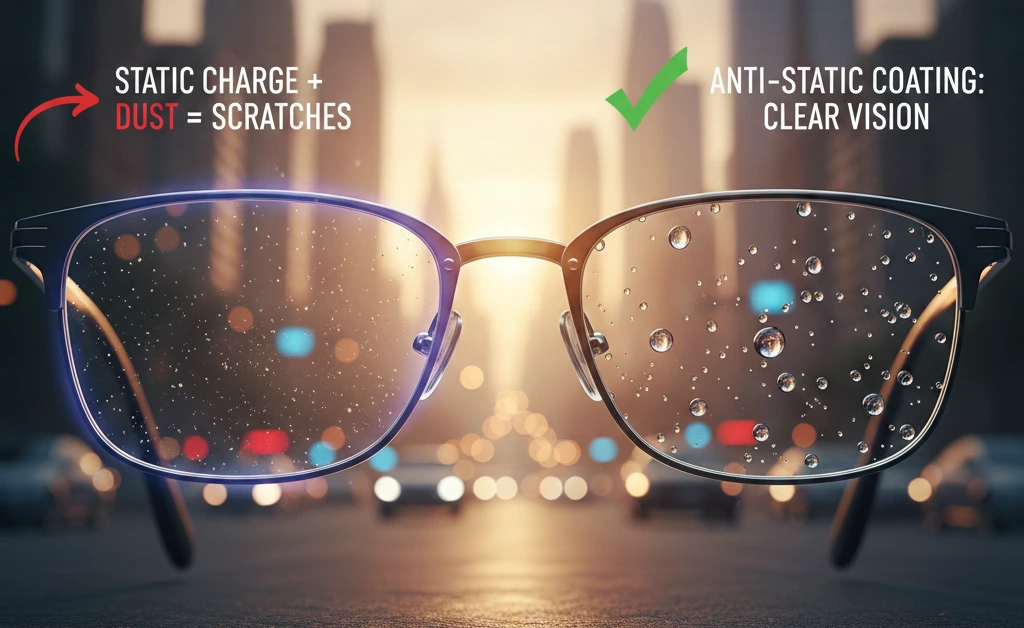
- The “Static” Trap: Standard lenses build up a static charge during cleaning, which acts like a magnet for urban pollution. Anti-static coatings are the only engineering-grade solution to break this cycle.
- Modern Lens Trade-offs: While polycarbonate and high-index lenses are safer and lighter than glass, they are chemically softer. Their durability depends entirely on the quality of their hard coating.
- The 30-Second Rule: Never wipe lenses immediately after coming in from the street. Allow particles to settle or, better yet, rinse them with water first to remove abrasive grit.
- Smart Cleaning: Use pH-neutral cleaners and high-GSM microfiber cloths. Avoid household detergents or clothing, which contain fibers and chemicals that degrade Anti-Reflective (AR) layers.
Final Reality Check
At GlaSight, we believe that understanding the engineering of your eyewear is the first step to crystal-clear vision. Don’t let urban dust dull your perspective treat your lenses like the precision instruments they are
Modern lenses aren’t worse they’re optimized for safety and comfort, not abuse.
Urban cities create conditions that demand better habits, not tougher materials alone.
Once you understand how scratches actually happen, prevention becomes simple not stressful.
If your lenses keep scratching:
- You’re not careless
- Your city environment is harsher than you think
- Small habit changes matter more than expensive upgrades
Clear lenses last longer when you treat them like precision surfaces, not durable objects.
That awareness alone extends lens life dramatically.
Frequently Asked Questions (FAQs)
Can I use dish soap to clean my glasses?
Yes, but only if it is pH-neutral and lotion-free. Avoid soaps with “moisturizers” as they leave a greasy film that can eventually degrade the AR coating.
Why do my scratches look blue or purple on glasses?
You are likely seeing the “Anti-Reflective” layers. When the coating is scratched, it exposes the different layers of the AR stack, which refract light in those specific colors.
How often should I wash my microfiber cloth?
In a dusty city, every 7–10 days. Wash it with mild soap, no fabric softener, and let it air dry.