

How to Hide Thick Lenses: 7 Frame Selection Tips
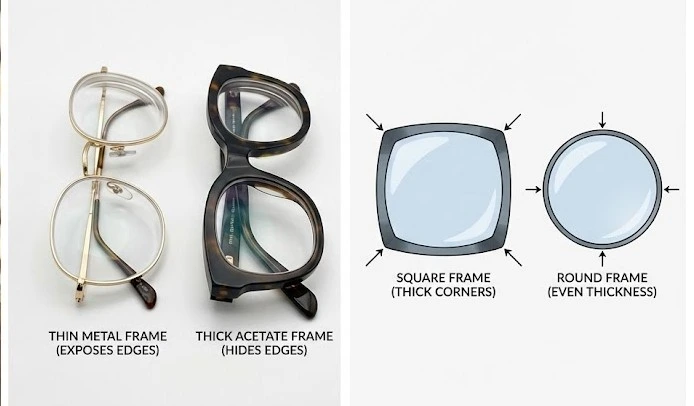
How to Hide Thick Lenses
- Frame Size is #1: Smaller lens width (under 52mm) drastically reduces edge thickness.
- Avoid Corners: Round and oval shapes hide thickness better than sharp squares.
- Thick Frames Hide Thick Lenses: Use acetate (plastic) frames to cover the lens edge; avoid thin metal or rimless styles.
- Color Matters: Dark frames (Black, Tortoise) mask thickness; Clear frames expose it.
- The “Side Profile” Test: Deep frames hide the lens bulge that is visible from the side.
- Fit: Your pupil should be centered to minimize uneven thickness at the edges.
If you wear a strong prescription, you’ve probably experienced this moment:
you pick up your glasses, turn them slightly to the side, and immediately notice how thick the lenses look.
From the front, everything seems fine. But from the side? The lenses suddenly feel bulky, heavy, and impossible to ignore. Some frames make this worse, while others somehow make the same prescription look cleaner and more balanced.
This isn’t luck. And it’s not about expensive lenses alone.
Thick lenses aren’t the real problem. Frame choice is.
With the right frame design, even high-prescription lenses can look surprisingly slim and intentional. This guide explains exactly how to hide thick lenses instead of highlighting it based on real-world design logic, not trends or marketing promises.
Table of Contents
Why High-Prescription Lenses Look Thick in the First Place
Before talking about frames, it helps to understand why lenses look thick at all.
Lens thickness is influenced by three main factors:
- Prescription strength
Stronger prescriptions require more lens material. This part is unavoidable. - Lens size
Larger lenses need more material at the edges, increasing visible thickness. - Frame design
This is where most people go wrong and where you have the most control.
You can’t change your prescription. But you can choose frames that visually minimize lens thickness, sometimes dramatically.
The Biggest Mistake: Choosing Oversized Frames
Oversized frames are one of the worst choices for high prescriptions.
Even if they look stylish, they work directly against you.
Why large frames make lenses look thicker:
- Larger lens diameter increases edge thickness
- More surface area = more visible lens edge
- Extra weight makes frames look front-heavy
- Side profile becomes exaggerated
A difference of just 2–3 mm in lens width can noticeably increase thickness at the edges.
What to do instead:
- Choose smaller lens widths
- Avoid “fashion oversized” styles
- Look for frames that fit close to your face
Simple rule:
Smaller lenses = thinner-looking lenses.
Why Frame Shape Matters More Than You Think
Frame shape plays a huge role in how lens thickness is distributed.
Best shapes for hiding thick lenses:
- Round
- Oval
- Soft rectangular
These shapes:
- distribute thickness evenly
- avoid sharp corners where lenses get thick
- look balanced from multiple angles
Shapes to be careful with:
- Large square frames
- Sharp rectangular designs
- Flat, wide lens openings
Corners are where lens thickness becomes most noticeable. Rounder shapes naturally soften that effect.
Frame Thickness Is Your Ally, Not Your Enemy
This is one of the most counterintuitive but important points.
Thin frames expose thick lenses.
Thicker frames hide them.
Why? Because the lens edge sits inside the frame. A thicker frame front covers more of that edge, acting like a visual shield.
What works well:
- Medium to thick acetate frames
- Frames with depth, not just width
- Solid rims that fully surround the lens
What usually doesn’t:
- Ultra-thin metal frames
- Wire frames
- Rimless or semi-rimless designs
If you want lenses to disappear, the frame needs enough material to hide them.
Color Choice Can Make or Break the Look
Color affects how noticeable lens thickness appears.
Best colors for high prescriptions:
- Black
- Dark tortoise
- Deep brown
- Navy
- Charcoal or dark gray
Dark colors reduce contrast between the lens edge and the frame, making thickness much less visible.
Colors to avoid (or use carefully):
- Clear or transparent frames
- Crystal or pale colors
- Light gold or silver metals
Clear frames are especially unforgiving they show every millimeter of lens edge.
Why Clear and Rimless Frames Are a Bad Idea
Clear frames may look modern, but they’re brutal for high prescriptions.
They:
- expose the entire lens edge
- remove any masking effect
- exaggerate thickness from every angle
Rimless and semi-rimless frames do the same thing. Without a full rim, there’s nowhere for the lens to hide.
If your goal is a slim look, these designs work against you, no matter how advanced your lenses are.
📊 Visual Thickness Estimator
Wondering how your specific frame and lens choice will actually look? Use our interactive guide to see the result before you buy.
Open the Lens Appearance Tool →Frame Depth Matters More Than Frame Width
Many people focus only on how wide a frame is. But depth how thick the frame is from front to back is just as important.
Deeper frames:
- conceal lens edges better
- reduce side bulge
- improve balance
A frame can look sleek from the front while still having enough depth to hide thickness from the side.
Bridge Design and Lens Positioning
Lens thickness is usually greatest at the edges. Where those edges sit on your face matters.
A well-designed bridge:
- positions lenses closer to the center of your face
- reduces extreme edge thickness
- improves symmetry
Poor bridge fit can exaggerate thickness and make lenses feel heavier than they actually are.
Temple Arms Can Balance the Look
The temples (arms) of your glasses also affect how thick lenses look.
Good temple design:
- Slightly thicker near the hinges
- Solid attachment points
- Gradual tapering toward the ears
This balances the visual weight of thick lenses. Thin wire temples paired with thick lenses often look mismatched and unintentional.
Why Frame Numbers Matter (And Most People Ignore Them)
Inside your frame arm, you’ll see numbers like: 52-18-140
These aren’t random.
- 52 = Lens width
- 18 = Bridge width
- 140 = Temple length
For high prescriptions:
- Smaller lens width helps reduce thickness
- Avoid overly wide bridges
- Keep the frame proportional to your face
Pro tip:
If your current glasses almost work, copy the numbers and adjust slightly smaller.
Don’t Fall for the “Lens-Only” Trap
Many people focus entirely on lens upgrades and forget the frame does most of the visual work.
A good frame can:
- hide edge thickness
- make lenses look slimmer
- improve comfort
- create a balanced profile
A poor frame can make even premium lenses look bulky.
Think of frames as camouflage not decoration.
Even the best frames need good glass. Read about “Why Premium Lenses Feel Different” to understand how high-quality materials reduce distortion.”
Comfort and Appearance Go Together
Thick lenses aren’t just about looks. Poor frame choice often leads to:
- front-heavy glasses
- nose pressure
- constant adjustments
Frames that hide thickness well are often more comfortable because they balance weight better.
Heavy lenses can cause glasses to slide. Learn how to fix balance issues in our guide: How to Choose Frames If You Wear Them All Day
Quick Checklist: Frames That Hide Thick Lenses
Choose frames that are:
✔ Smaller lens width
✔ Round, oval, or softly rectangular
✔ Medium to thick rim depth
✔ Dark or opaque colors
✔ Full-rim designs
✔ Balanced with solid temples
Avoid frames that are:
✘ Oversized
✘ Clear or transparent
✘ Ultra-thin metal
✘ Rimless or semi-rimless
✘ Sharp-cornered
Realistic Expectations: What Frames Can and Can’t Do
Frames can:
- hide edge thickness
- improve balance
- make lenses look intentional
Frames cannot:
- eliminate thickness completely
- override extremely high prescriptions
- fix poor lens centering
The goal isn’t invisibility it’s balance and proportion.
Why Some People Look Great With High Prescriptions
You’ve probably seen people with strong prescriptions whose glasses look perfectly normal.
It’s not because their lenses are magically thinner.
It’s because their frames were chosen correctly.
Once the frame works with the lenses, thickness fades into the background.
Final Thought
High-prescription lenses don’t have to define how your glasses look.
Most of the “thick lens problem” isn’t the prescription it’s the frame choice. When frames are chosen with intention, even strong lenses can look clean, balanced, and surprisingly slim.
The secret isn’t hiding your prescription.
It’s choosing frames that respect it.
When that happens, thickness stops being the first thing people notice and becomes something only you ever think about.
Frequently Asked Questions (FAQs)
Can thick lenses really be hidden, or is it just marketing?
They can’t be made invisible, but they can be made far less noticeable. The right frame size, shape, thickness, and color can dramatically reduce how thick lenses look from the front and side.
Do smaller frames really make lenses look thinner?
Yes. Smaller lens widths reduce edge thickness because less lens material is needed. Even a few millimeters difference can noticeably improve how thick lenses appear.
Are round frames better than square frames for high prescriptions?
Generally, yes. Round and oval frames distribute lens thickness more evenly, while square frames create thick corners that make lenses look bulkier.
Should people with high prescriptions avoid metal frames?
Very thin metal frames usually highlight lens edges. If you prefer metal, choose frames with thicker rims or added depth rather than ultra-thin wire designs.
Why do clear frames make thick lenses look worse?
Can thick lenses really be hidden, or is it just marketing?
They can’t be made invisible, but they can be made far less noticeable. The right frame size, shape, thickness, and color can dramatically reduce how thick lenses look from the front and side.
Do smaller frames really make lenses look thinner?
Yes. Smaller lens widths reduce edge thickness because less lens material is needed. Even a few millimeters difference can noticeably improve how thick lenses appear.
Are round frames better than square frames for high prescriptions?
Generally, yes. Round and oval frames distribute lens thickness more evenly, while square frames create thick corners that make lenses look bulkier.
Should people with high prescriptions avoid metal frames?
Very thin metal frames usually highlight lens edges. If you prefer metal, choose frames with thicker rims or added depth rather than ultra-thin wire designs.
Does frame color really affect lens thickness appearance?
Yes. Dark, opaque colors reduce contrast between the frame and lens edge, making thickness blend in visually. Light or transparent colors exaggerate it.
Are rimless or semi-rimless frames a bad idea for strong prescriptions?
For most high prescriptions, yes. Without a full rim, there’s nothing to hide the lens edge, which makes thickness very noticeable.





One Comment